
1255 · Xinghua Harbor, Fujian
Five hundred strings of foreign debt and one small coastal junk.
You play Chen Zilong, a county-school student from the Yuhu branch of the Chen clan in Putian. After your uncle’s ship goes down on a southern voyage, a five-hundred-string loan stamped with an Arab merchant’s cinnabar seal falls to you. At the harbor mouth of Xinghua, you have to choose between returning to the examination hall and putting to sea to pay off the ledger.
Across four chapters from 1255 to 1279, you sail between fourteen ports from Quanzhou, Mingzhou, Tamna, and Hakata down to Champa. Between story beats, the sea lanes are yours to trade; as the Mongol Yuan armies push south, prices, blockades, and the war on land catch up with your ship.
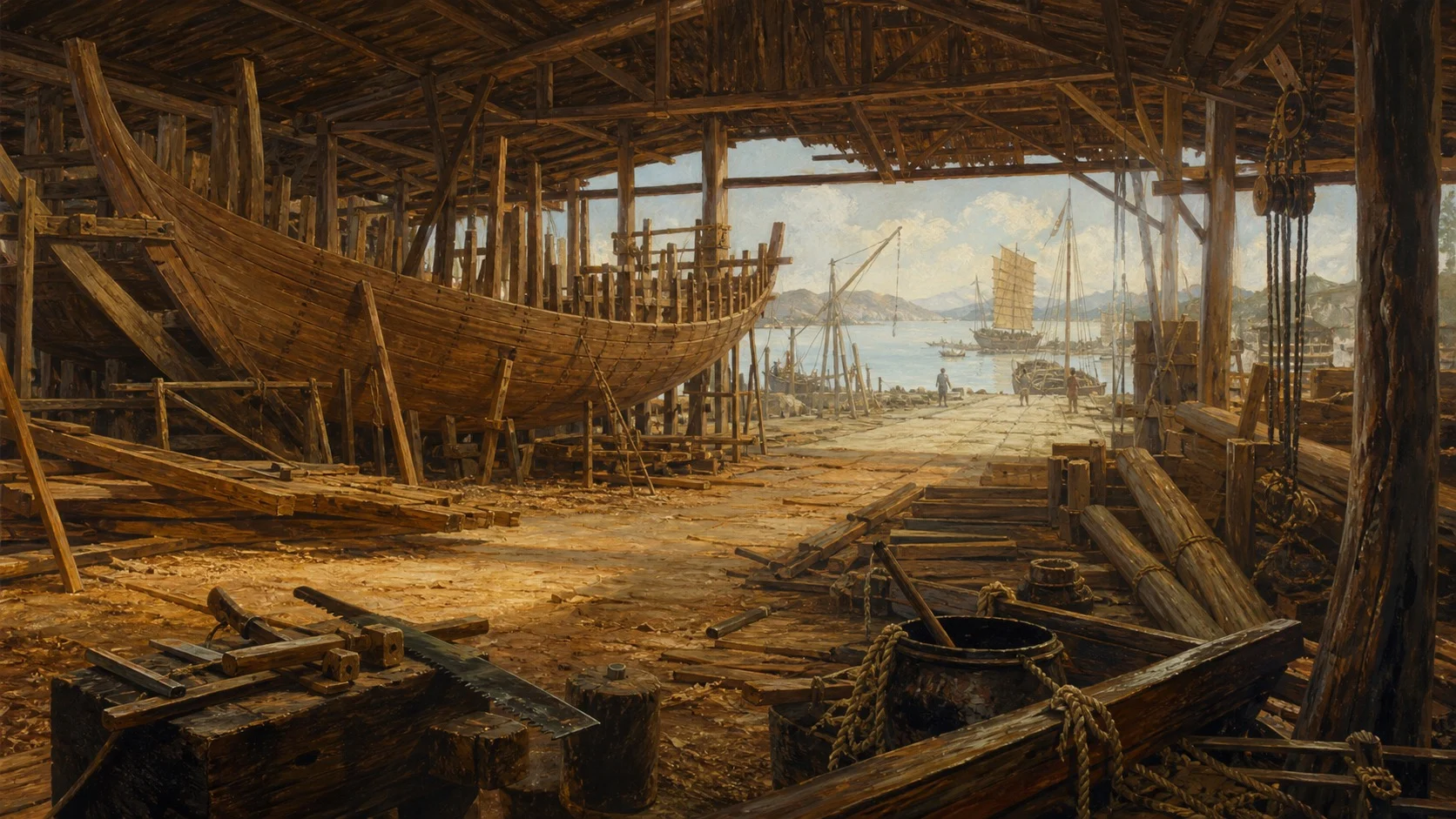 Environment artwork
How a voyage works
01Cargo, permits, and broker contracts
Twenty-nine goods (qingbai porcelain, raw silk, aromatics, Japanese copper, swords, and grain) move between producing and consuming ports. Dumping too much cargo in one harbor crashes the local price, and contraband risks seizure at the maritime customs office. Broker contracts carry strict deadlines, while higher customs standing lowers tariffs and opens credit.
02Monsoons, sea lanes, and provisions
Sail south on the winter northeast winds and return north on the summer monsoon. Before clearing port, choose between direct compass bearings, open-sea crossings, or hugging the coast. Fresh water and grain tick down day by day; run dry for twenty-eight days at sea and the crew will mutiny.
03Eight ship types and shipboard roles
Work your way up from a small coastal junk to fast galleys and three-masted Fuchuan merchantmen. Refit hulls, gun ports, and holds at the shipyard, and assign officers across your fleet: pilots to read the weather and compass, helmsmen to hold course, interpreters for foreign ports, and physicians to keep the crew alive.
04Broadside combat, blockades, and sieges
Handle the helm and sails in real time, cycle ammunition, launch fire ships downwind, hang wet felt screens against fire arrows, or cut grappling lines to break free. Boarding actions play out in multi-round deck fights, with escort ships following your battle orders. In the later chapters, voyages turn to running grain through blockades, defending Xinghua, and breaking out at Yamen.
Before you set sail
What kind of game is this?
A single-player historical maritime trading and strategy game set in the East Asian seas between 1255 and 1279, built with Godot 4.6. Most of your time goes into running trade routes, fulfilling contracts, and managing a fleet, punctuated by four story chapters, real-time naval battles, and city defense.
How far along is development?
All four chapters, fourteen ports, twenty-nine trade goods, naval combat, the siege of Xinghua, and four endings are playable from start to finish. We are currently wiring up the expanded companion roster, tuning balance, and adding sound effects. There is no public demo yet.
How closely does it follow history?
Of the 75 characters in the game, 41 are historical figures, including Wen Tianxiang, Zhang Shijie, Lu Xiufu, Pu Shougeng, Bayan, Takezaki Suenaga, and the Quanzhou pilot Zheng Zhen recorded in the History of Yuan. Dates, offices, sea lanes, and trade goods are checked against period sources, alongside fictional characters and dramatic adaptations written for the story.
When will it come out, and on which platforms?
Release date, pricing, and storefront plans are not set yet. Desktop builds run on Windows, macOS, and Linux in internal testing; we will post here once release plans are firm.
Will the game be available in English?
In-game text is currently Chinese only, written in a style modeled on Song–Yuan notes and official dispatches. This English site is an overview of the project; localization plans have not been decided.